How to Verify Peptide Purity Before Research
· Peptastic Labs
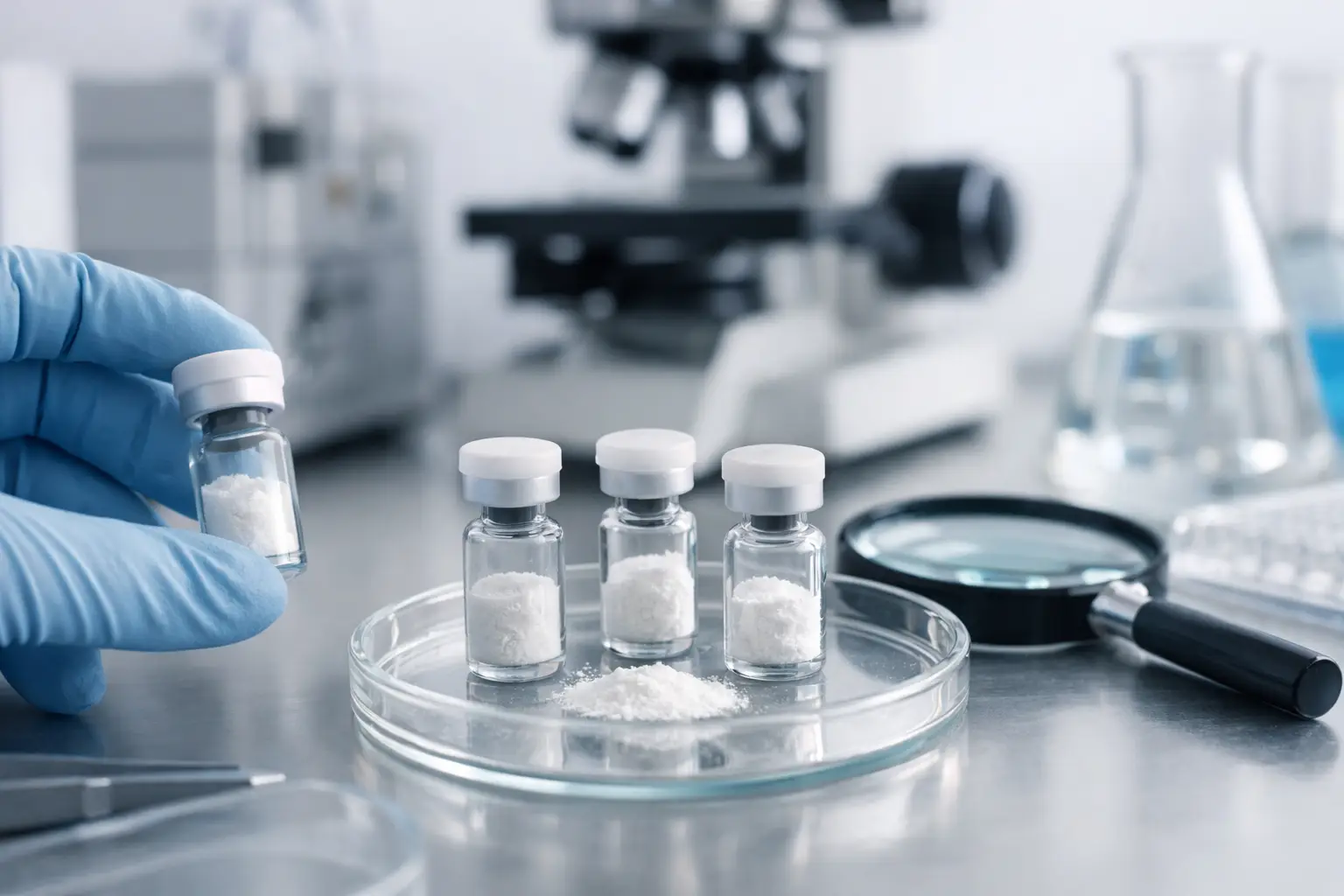
A peptide labelled 99% pure may be suitable for one experiment and a poor fit for another. The difference is not just the number on a product page. To understand how to verify peptide purity, researchers need to connect the stated percentage to the exact batch, the analytical method, the chromatogram and the material’s intended research use.
Purity is one part of a wider quality picture. Identity, peptide content, residual solvents, counterion, moisture and handling history can all affect how reliably a material performs in a laboratory setting. A credible supplier makes those details traceable rather than asking buyers to accept a broad claim at face value.
Start with a lot-matched Certificate of Analysis
The Certificate of Analysis, or COA, is the first document to review. It should relate to the precise lot or batch being purchased, not a generic example certificate generated for a different production run. A lot number on the vial, product label and COA should match exactly. If documentation is accessed by QR code, scanning it should lead to the relevant batch record rather than a general product page.
At a minimum, a useful peptide COA identifies the peptide name, lot number, reported purity, analytical methods, molecular mass and test date. It should also name the laboratory or testing party where applicable. Batch-specific documentation creates a chain of traceability from the material in hand to the test result used to support its specification.
A missing lot number is a practical warning sign. So is a COA that reports a high purity percentage but provides no method, no chromatogram and no mass result. These omissions do not automatically prove the material is unsuitable, but they prevent a researcher from assessing the claim with confidence.
How to verify peptide purity with HPLC data
High-performance liquid chromatography, commonly shortened to HPLC, is the method most often used to report peptide purity. The sample is separated into components as it moves through a chromatographic column. Each component produces a peak at a given retention time. In a straightforward purity result, the principal peak should account for the stated proportion of the chromatogram’s integrated area.
For example, a reported HPLC purity of 98% generally means the main peak represents approximately 98% of the measured UV area under the specified test conditions. The remaining 2% may include deletion sequences, truncated products, oxidation products, protecting-group remnants or other synthesis-related impurities. The method does not, by itself, identify every minor peak.
Ask to see the chromatogram, not merely the final percentage. A clean result usually shows one dominant, well-resolved main peak with small secondary peaks. A broad main peak, shoulders around the target peak, an unexplained cluster of peaks or a baseline that makes integration difficult deserve further scrutiny. The chromatogram should show the retention time, detector wavelength, integration values and test conditions where possible.
HPLC purity also has limits. UV response varies between compounds, so area percentage is not always the same as mass percentage. It is an analytical estimate based on the chosen method. Comparisons are most useful when the same technique, wavelength and conditions are used across batches. A supplier that specifies reverse-phase HPLC or UPLC conditions gives researchers more context than one that simply states “tested for purity”.
Consider the purity specification in context
Higher purity is not always the only purchasing criterion. Early assay development may tolerate a different specification from work that requires tightly controlled impurity profiles, such as receptor-binding, analytical reference or mechanistic studies. Longer and structurally complex peptides can also be more difficult to synthesise and purify consistently than short sequences.
The right question is therefore not simply, “Is 98% enough?” It is, “Is the documented impurity profile appropriate for this protocol, readout and level of experimental risk?” When a minor impurity could plausibly affect the result, a higher specification or independent confirmation is prudent.
Confirm identity with mass spectrometry
HPLC can show separation, but mass spectrometry helps establish that the dominant component has the expected molecular mass. A COA should report the calculated mass for the intended peptide and the observed mass from analysis, often by LC-MS or MALDI-TOF MS. Small differences may reflect the ion form used in the measurement, such as [M+H]+ or [M+Na]+, so the result must be interpreted with the stated method in mind.
Mass confirmation is essential because a clean-looking chromatographic peak is not sufficient proof of sequence identity. A related peptide impurity can elute close to the target, and an incorrectly assigned material may still produce a dominant peak. Matching observed and expected mass supports identity, while HPLC quantifies the relative chromatographic purity. Together, they provide a more defensible quality assessment than either result alone.
For higher-stakes research, consider whether intact mass is enough. Intact MS confirms the overall molecular weight but cannot always distinguish positional isomers or confirm sequence order. Peptide mapping, tandem mass spectrometry or amino acid analysis may be appropriate where sequence-level confirmation is necessary. The depth of verification should scale with the experimental consequences of an incorrect assignment.
Do not confuse purity, content and quantity
A vial can contain peptide that is 99% pure by HPLC while the total peptide content is lower than expected because of water, salts, residual trifluoroacetic acid or other non-peptide mass. This distinction matters when preparing solutions at a precise molar concentration.
Counterions are especially relevant. Peptides supplied as acetate, trifluoroacetate or another salt have a molecular mass and handling profile influenced by that form. The COA or accompanying specification should identify the counterion where known. Water content and net peptide content are also useful values for quantitative work, particularly if experiments demand accurate dosing in vitro.
Similarly, analytical purity does not establish sterility, endotoxin level or freedom from microbial contamination. Those are separate specifications requiring separate tests. Do not infer them from an HPLC result. Researchers working with sensitive cell systems should assess the documentation needed for their specific protocol rather than assuming a purity claim covers all quality attributes.
Assess third-party testing and documentation quality
Third-party testing can add meaningful independence, particularly when the laboratory, method and lot number are disclosed. It is not a magic phrase, though. The value lies in whether the report is attributable, batch-specific and technically interpretable.
A strong documentation set includes a clearly identified testing laboratory or analytical partner, a matching lot number, a dated result, named methods and underlying outputs such as chromatograms or spectra. It should be possible to identify what was tested and when. A vague badge saying “lab tested” offers considerably less evidence than a report that allows the buyer to examine the data.
Document control matters as much as the individual result. Check whether the supplier provides the COA before or at dispatch, maintains accessible lot records and uses consistent identifiers on labels and packaging. Research procurement becomes simpler when a material can be traced without chasing documents after an experiment has already begun.
Know when to arrange independent testing
For many routine research applications, a transparent, lot-matched COA supported by HPLC and mass spectrometry is a reasonable starting point. Independent testing becomes more compelling when the work is high value, the data will support a publication, the material has been stored for an extended period, or results conflict with prior observations.
Retain a representative sample and record the lot number, receipt date, storage conditions and reconstitution details. A qualified analytical laboratory can repeat HPLC and LC-MS testing, while specialised methods may be used to investigate oxidation, aggregation, sequence variants or concentration. This step adds time and cost, but it can prevent a questionable reagent from distorting a larger study.
Independent verification is also useful after an unexpected shipping delay or suspected temperature excursion. Many peptides are stable as lyophilised powders under appropriate storage, but stability varies by sequence, modification and formulation. Follow the supplier’s storage guidance, minimise unnecessary freeze-thaw cycles after reconstitution and document preparation conditions. Sound handling preserves the value of the original quality evidence.
Build verification into your purchasing process
The most reliable approach is to review documentation before the material enters the experiment. Confirm the required purity specification, request or access the lot-matched COA, inspect HPLC and mass data, then record the batch in the laboratory inventory. This creates a practical audit trail and makes it easier to compare results across repeat orders.
When sourcing research-grade peptides, prioritise suppliers that make verification straightforward: clear research-use-only positioning, batch traceability, third-party testing where stated and analytical data that can be reviewed rather than merely claimed. Peptastic Labs applies this documentation-first approach through lot-matched COAs and verified purity records for research materials.
A peptide is only as useful as the confidence researchers can place in its identity and composition. Treat each COA as part of the experimental record, not a marketing attachment, and the quality of your procurement decisions will show up in the quality of your data.
For research use only. Not for human or veterinary use. Not for consumption. Nothing in this article is medical advice or a recommendation for use in humans or animals.