Lyophilised Peptide Storage Temperature Guide
· Peptastic Labs
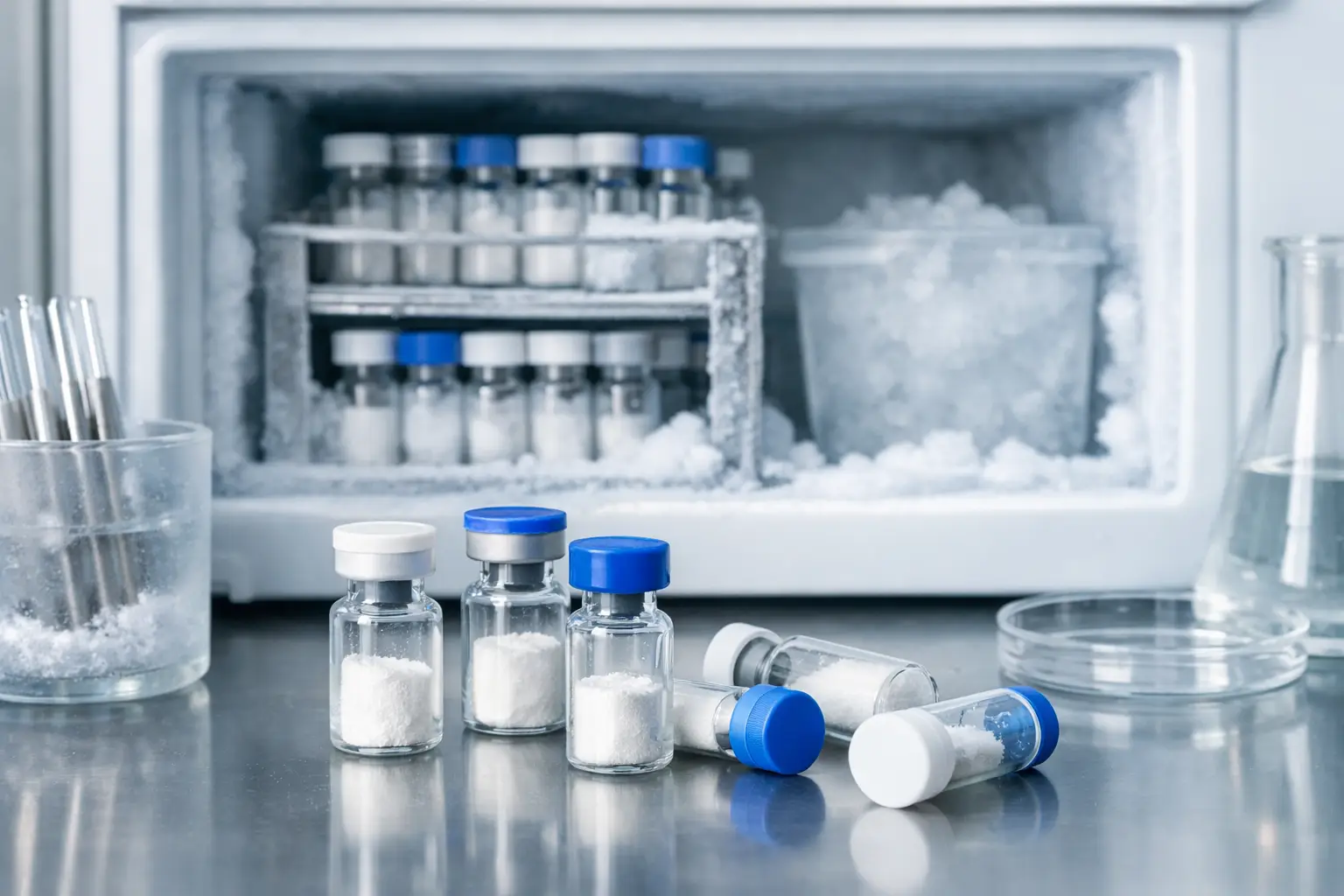
A vial can arrive with verified purity and a lot-matched Certificate of Analysis, then lose practical research value through one weak point: uncontrolled handling after receipt. Lyophilised peptide storage temperature is not a cosmetic label detail. It helps determine whether the material remains dry, chemically stable and traceable to the condition under which it was supplied.
For research-grade peptides, the correct storage decision starts with the product-specific label, technical documentation and supplier guidance. There is no single temperature that applies to every sequence, salt form or formulation. A conservative laboratory workflow protects the vial from heat, moisture, repeated temperature cycling and documentation gaps while keeping the original lot identity intact.
Why temperature matters for lyophilised peptides
Lyophilisation removes water from a peptide preparation under controlled conditions, leaving a dry cake or powder intended to improve stability relative to an aqueous solution. Reduced water activity can slow several degradation pathways, but it does not make a peptide indestructible. Heat, oxygen, light and moisture can still affect the material, particularly over longer storage periods.
Temperature is closely linked to reaction rate. As storage temperature rises, chemical changes can become more likely or proceed more quickly. Depending on peptide structure and formulation, relevant risks may include oxidation, deamidation, hydrolysis and aggregation. Hygroscopic materials present an additional concern: once moisture enters the vial, the stability advantage of the lyophilised state may be reduced.
The practical question is therefore not simply, “Should this go in a freezer?” It is whether the selected condition matches the supplier’s stated storage requirement and whether the laboratory can maintain that condition consistently. A well-run -20°C freezer with controlled access is generally more useful than a colder unit that experiences frequent door openings, frost build-up or unrecorded temperature excursions.
Recommended lyophilised peptide storage temperature: follow the product record
For many research peptides, refrigerated or frozen storage may be specified, with -20°C commonly used for longer-term storage. Some materials may require colder conditions, such as -80°C, while others may be stable under controlled refrigerated conditions for a defined period. The correct answer is always product dependent.
Start with the vial label, product specification and lot-specific documentation. These records should identify the material, batch or lot number, storage guidance, retest or expiry information where supplied, and the analytical basis for identity and purity. If the vial and documentation do not match, pause before assigning the material to a study.
It is tempting to impose a single site-wide rule such as “all peptides at -80°C”. That approach can be appropriate for some inventories, but it is not automatically superior. Ultra-low storage adds operational complexity, including greater risk of condensation during removal and return. A peptide stored at -80°C should not be repeatedly brought to ambient temperature merely to retrieve a small amount. In those circumstances, thoughtful aliquoting or planned vial use may matter more than choosing the lowest available set point.
Short-term handling versus long-term storage
Short periods at room temperature during receiving, stock checks or careful transfer may be unavoidable. Whether they are acceptable depends on the supplier’s guidance, packaging, duration and the peptide itself. Record meaningful deviations rather than assuming any excursion has rendered the material unusable or, conversely, dismissing a prolonged warm exposure without review.
For long-term retention, limit time outside the specified storage environment. If samples are moved between facilities, use a validated shipping configuration suitable for the required range and document dispatch, receipt and any apparent condition changes. The research record should distinguish between a planned controlled transfer and an unknown exposure event.
Moisture control is as important as freezer temperature
A freezer does not eliminate moisture risk. In fact, moving a cold vial into humid laboratory air can create condensation on the outside of the container and, if opened too soon, potentially introduce moisture into the vial headspace. This is particularly relevant for small, high-value peptide quantities where repeated access is expected.
Allow a sealed vial to equilibrate to ambient temperature before opening it, unless product-specific instructions state otherwise. Keeping the cap closed during this period reduces the chance that warm, humid air contacts the cold material. Once the vial is opened, minimise the time exposed to room air and reseal it promptly.
Desiccant and secondary containment can provide useful extra protection where appropriate. A clearly labelled sealed pouch or secondary container also reduces confusion between lots and offers some protection from freezer frost, spills and handling damage. The objective is not elaborate packaging for its own sake. It is maintaining a dry, identifiable material in the same condition assumed by the analytical documentation.
Reduce freeze-thaw and access events
Lyophilised material is often more tolerant of storage than a reconstituted peptide, but repeated temperature swings are still poor practice. Each cycle can increase condensation risk, create opportunities for labelling mistakes and expose the material to variable conditions.
Where study design permits, allocate inventory by intended use. An unopened reserve vial can remain in long-term storage, while a separate working vial is used for near-term preparation. For high-frequency work, researchers may consider preparing appropriately sized solution aliquots only when the available stability data, solvent compatibility and protocol support that decision.
Aliquoting is not automatically beneficial. It introduces handling steps, potential adsorption losses, contamination risk and a new chain of records. The right approach depends on vial quantity, expected number of uses, the assay schedule and the available validated procedures. Avoid adopting an aliquoting routine simply because it is common in another laboratory.
Reconstituted peptides require a separate stability assessment
Once a peptide is reconstituted, storage assumptions change. Solvent composition, concentration, pH, container material, microbial control and the peptide’s sequence can all affect stability. A dry-vial storage recommendation should never be treated as a stability claim for the reconstituted solution.
Document the reconstitution date, solvent, final concentration, operator, storage condition and planned discard or review date. If a study demands extended solution storage, establish suitability through supplier information, published method support where relevant, or fit-for-purpose analytical verification. For critical experiments, checking identity and purity after the intended storage interval may be more defensible than relying on a general rule of thumb.
Build storage controls around traceability
Temperature control only has value if it can be demonstrated. At a minimum, laboratories should maintain an inventory record that connects the storage location to the peptide name, lot number, receipt date, specified condition and current status. The original vial label should remain legible throughout use.
A practical control system also records freezer temperatures and alerts staff to failures or significant excursions. Continuous monitoring is preferable for materials supporting time-sensitive or high-value work, but even a smaller research operation benefits from routine checks and a defined response plan. Know who will relocate material, where it will go, and how the event will be documented if equipment fails outside normal hours.
Lot matching deserves particular attention. A Certificate of Analysis confirms the tested batch, not every unlabelled tube that may later appear in a rack. When transferring material, retain the original lot reference on every working container. This supports reproducibility, helps investigators compare results across batches and makes it possible to review whether an unexpected result could relate to material history.
Receiving research-grade peptides without losing the chain of control
The first storage decision occurs at delivery. Inspect the outer packaging and confirm that the product name, amount, lot number and accompanying documentation align with the purchase record. If cold packaging was expected, note its condition on arrival. Then move the vial to its specified environment without leaving it on the bench during unrelated receiving tasks.
Peptastic Labs provides research-use-only materials with batch-specific documentation designed to support this chain of control. Researchers should retain the relevant Certificate of Analysis alongside internal inventory records, especially where multiple lots of the same peptide may be active in a programme.
Research use only is more than a label. These materials are intended for laboratory and preclinical research, not for human or veterinary administration. Sound storage, clear records and lot-level verification are part of responsible research practice because they protect the interpretability of the work.
When to review the material before use
A change in appearance does not always prove degradation, but it should prompt review. Discolouration, an altered cake structure, visible moisture, a compromised stopper, missing lot information or an unexplained temperature event are all reasons to quarantine the vial until the record is assessed.
For exploratory work, the response may be as simple as documenting the concern and replacing the vial. For work supporting a larger research decision, analytical confirmation may be warranted. The appropriate threshold depends on the study’s consequences, the material’s scarcity and whether comparable verified stock is available.
The most useful storage routine is usually the least complicated one that staff can follow every time: use the documented condition, keep vials dry and sealed, limit access events, preserve lot identity and investigate meaningful excursions before the material enters an experiment.
For research use only. Not for human or veterinary use. Not for consumption. Nothing in this article is medical advice or a recommendation for use in humans or animals.