MOTS-c Mitochondrial Research: What It Shows
· Peptastic Labs

A 16-amino-acid peptide encoded within mitochondrial DNA has become a serious point of interest for metabolic and ageing biology. MOTS-c mitochondrial research sits at the intersection of mitochondrial signalling, cellular stress adaptation and whole-body energy regulation, but the evidence must be interpreted according to model, endpoint and study quality. It is a research field with intriguing mechanistic signals, not a basis for consumer-health claims.
What is MOTS-c?
MOTS-c is a mitochondrial-derived peptide, commonly described as being encoded within the mitochondrial 12S ribosomal RNA region. That origin matters. Mitochondria are often introduced as cellular energy producers, yet they also act as signalling hubs that respond to nutrient availability, exercise-like stress, oxidative pressure and changes in energy demand.
Unlike a conventional nuclear-encoded peptide, MOTS-c provides a useful model for examining communication between mitochondrial status and broader cellular behaviour. Experimental work has reported that MOTS-c can relocate to the nucleus under certain metabolic stress conditions, where it may influence the expression of genes involved in stress responses and metabolic adaptation. This proposed mitochondria-to-nucleus signalling role is central to current interest in the peptide.
The field is still comparatively young. Results from cultured cells and animal models can guide hypotheses, but they cannot be treated as direct evidence of equivalent outcomes in humans. For researchers, that distinction is not a caveat to place at the end of a discussion. It should shape the research question from the outset.
Why MOTS-c mitochondrial research matters
Metabolic dysfunction is not driven by one pathway. Glucose handling, lipid utilisation, mitochondrial turnover, inflammatory signalling, skeletal-muscle function and nutrient sensing all interact. A peptide that appears to respond to cellular energy stress may therefore offer a useful experimental tool for studying how those systems communicate.
One frequently discussed pathway is AMP-activated protein kinase, or AMPK. AMPK is activated when cellular energy availability is constrained and is broadly associated with a shift towards energy-conserving and substrate-generating processes. Preclinical studies have associated MOTS-c exposure with AMPK-related signalling and altered glucose metabolism. However, pathway association is not the same as establishing a single, universal mechanism. Effects can depend on cell type, species, dose, exposure duration, nutritional state and the analytical method used.
This is particularly relevant in skeletal-muscle research. Muscle is a major site of glucose disposal and a responsive tissue during exercise and energy stress. MOTS-c has been examined in relation to exercise adaptation, insulin sensitivity and metabolic flexibility, making it relevant to experimental designs focused on muscle signalling. The appropriate interpretation remains narrow: these findings support further investigation into mechanisms, rather than claims about performance, recovery or treatment.
The exercise and ageing connection
Observational and preclinical work has also prompted questions about MOTS-c in ageing biology. Mitochondrial function changes with age, while reduced metabolic flexibility and altered stress responses are common areas of investigation in age-related research. Some human studies have explored circulating MOTS-c levels in relation to age, physical activity or metabolic measures.
Those associations are useful but limited. A circulating biomarker may reflect a physiological state without causing it. Differences in participant selection, assay design, timing of sample collection and physical activity status can materially affect findings. For this reason, studies of MOTS-c and ageing should separate three questions: whether levels differ between groups, whether those levels predict a measured outcome, and whether manipulating the peptide produces a causal effect.
The key evidence: promising, but model-dependent
The strongest rationale for continued MOTS-c work comes from converging preclinical observations rather than one definitive experiment. Cellular studies have helped identify potential localisation and transcription-related effects. Rodent models have been used to investigate glucose regulation, diet-associated metabolic stress and physical activity-related outcomes. Human work remains more limited and often observational.
That evidence profile creates a practical trade-off. The peptide is scientifically interesting precisely because it connects several active research areas, yet broad relevance can encourage overinterpretation. A result in a high-fat-diet mouse model, for example, may not transfer to a sedentary human population, a trained cohort or a different metabolic context. The underlying phenotype, intervention schedule and comparator all matter.
Researchers evaluating a MOTS-c paper should look beyond the abstract. Useful questions include whether the study used endogenous measurement, exogenous peptide administration or both; whether peptide identity and purity were verified; whether the investigators measured functional endpoints rather than only gene expression; and whether the design accounts for sex, age, diet and circadian timing. These variables are not administrative details. Each can influence mitochondrial and metabolic readouts.
Designing informative MOTS-c experiments
A productive research programme begins with a defined biological question. “Does MOTS-c improve metabolism?” is too broad to yield a clean experimental design. More useful questions focus on a specific context, such as whether a defined exposure alters AMPK-associated markers in a chosen cell line under glucose restriction, or whether it changes substrate utilisation in a controlled animal model.
For cell-based work, investigators should establish baseline metabolic conditions before introducing a peptide. Media glucose concentration, serum conditions, cell confluence and passage number can influence AMPK activity and mitochondrial stress markers. Time-course sampling is often more informative than a single terminal time point, especially where nuclear localisation or transcriptional responses are proposed.
In vivo work introduces further considerations. Animal strain, age, sex, diet composition, handling stress and activity level can all shape the metabolic phenotype. If the study concerns exercise-related signalling, the timing of administration and tissue collection relative to activity should be pre-specified. A tissue result taken immediately after exertion may answer a different question from one taken after recovery.
Controls should match the intended interpretation. Vehicle controls are fundamental, but researchers may also need positive pathway controls, pair-fed designs or activity-matched groups depending on the endpoint. Blinding, randomisation and transparent exclusion criteria are especially valuable where effect sizes are modest or physiological measurements are variable.
Choosing endpoints that answer the question
MOTS-c research can produce a large panel of possible measurements, but more data does not automatically produce more clarity. For metabolic studies, functional measures such as glucose tolerance, insulin response, respiratory flux or substrate oxidation may provide stronger context than isolated changes in messenger RNA. Molecular endpoints can then help test the proposed mechanism.
For mitochondrial-focused experiments, it is worth distinguishing mitochondrial content from mitochondrial function. Changes in markers of biogenesis, for example, do not independently demonstrate improved respiratory capacity. Likewise, a shift in a signalling protein’s phosphorylation state can be biologically meaningful without proving a downstream physiological outcome.
The most convincing studies connect molecular findings to an endpoint that is relevant to the model. That might mean pairing transcriptional analysis with respiration data in cells, or connecting tissue signalling changes with a well-controlled metabolic phenotype in animals.
Material identity and documentation are part of the method
MOTS-c is a short peptide, but short sequence length does not remove the need for analytical scrutiny. Sequence identity, purity, peptide content, residual solvents, salt form and lot-to-lot consistency can affect reproducibility. A material labelled as MOTS-c without accessible batch documentation leaves researchers with avoidable uncertainty before the experiment has begun.
For research procurement, a batch-specific Certificate of Analysis should be reviewed alongside the intended assay. The documentation should clearly match the lot received and identify the analytical methods used. Third-party testing or independently supported purity evidence can add confidence, although the relevance of a reported purity figure still depends on how it was measured and what impurities were assessed.
Storage, reconstitution and handling should follow the supplier’s product-specific documentation. Researchers should record lot number, reconstitution conditions, aliquoting approach and freeze-thaw history in the laboratory record. These simple controls are particularly useful when comparing experiments conducted across different dates or peptide batches.
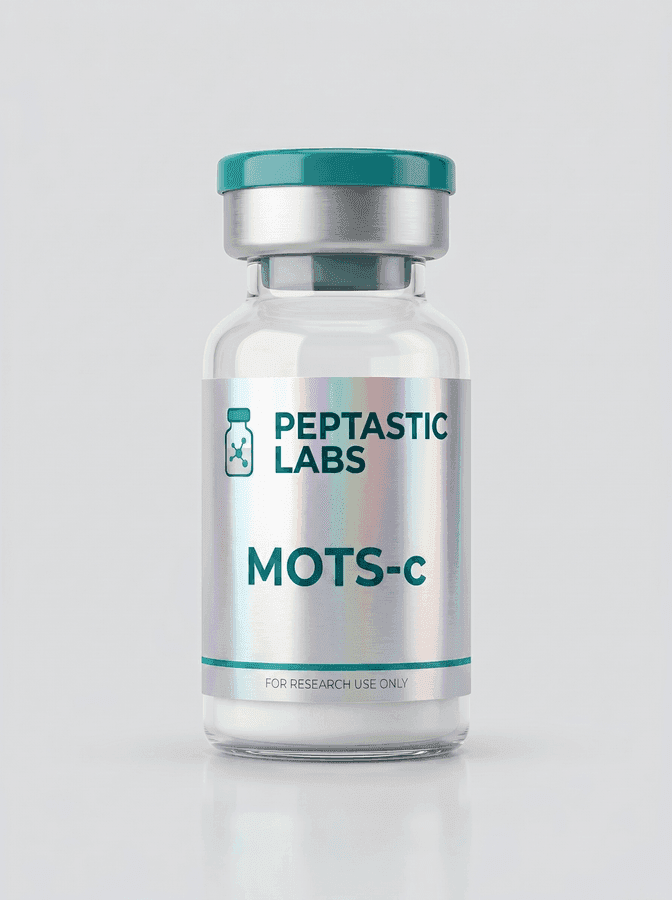
Peptastic Labs positions research compounds with lot-matched documentation and research-use-only handling in mind. For laboratories studying emerging peptides, traceability is not merely a purchasing preference. It is part of building results that can be reviewed, repeated and interpreted with confidence.
Where the field should go next
The next useful phase of MOTS-c research is likely to be more rigorous comparison across models rather than broader claims. Replication using well-characterised material, standardised assays and clearly defined metabolic states would help establish which findings are dependable. Human studies will also need sufficient sample size, carefully chosen populations and meaningful endpoints if they are to move beyond association.
There is value in studying what does not change as well. If MOTS-c effects are restricted to particular stress states, tissues or dosing windows, defining those boundaries may reveal more about its biology than an overly general positive result. The most useful contribution to this field may be a carefully controlled experiment that narrows the mechanism and makes the next research question sharper.
For research use only. Not for human or veterinary use. Not for consumption. Nothing in this article is medical advice or a recommendation for use in humans or animals.