Research Peptide Storage Guidelines That Hold Up
· Peptastic Labs
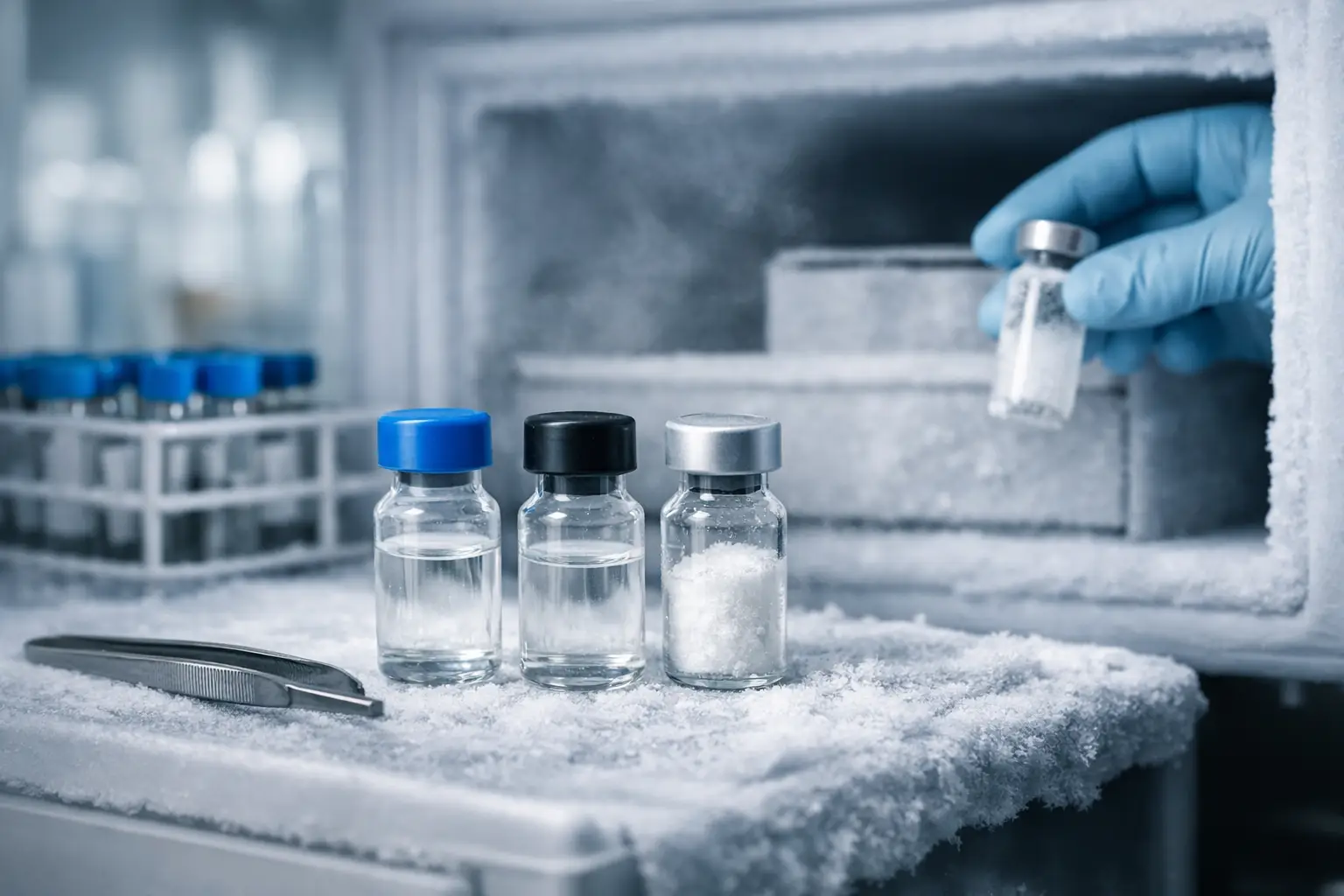
A peptide can arrive with strong analytical documentation and verified purity, then become a source of avoidable variability through poor handling. Research peptide storage guidelines are therefore not an administrative detail. They are part of protecting compound identity, maintaining usable material and producing results that can be interpreted with confidence.
For research-use-only materials, storage decisions should begin with the product-specific documentation. A Certificate of Analysis confirms attributes for a defined lot at the time of testing; it does not make every peptide equally stable in every solvent, temperature range or working condition. Sequence, modification, formulation, vial closure, moisture exposure and intended study duration all influence the appropriate approach.
Research Peptide Storage Guidelines Begin With the Lot
Before placing a vial into general laboratory storage, record the product name, lot number, receipt date, stated storage condition and associated Certificate of Analysis. Keep the vial and its documentation matched. This straightforward control becomes valuable when comparing experimental outcomes across lots, investigating an unexpected result or preparing material for a repeat study.
The product label and lot-matched documentation should take priority over general online advice. Many lyophilised research peptides are commonly stored frozen for longer-term stability, while some materials may have specific requirements relating to temperature, light or desiccation. A blanket rule such as “freeze everything at -20 °C” is convenient, but it is not a substitute for the manufacturer’s stated conditions.
On receipt, inspect the shipping condition before opening or transferring materials. If a temperature-sensitive order arrives with depleted dry ice, thawed cold packs, condensation inside secondary packaging or apparent vial damage, document the condition promptly. Record photographs, retain the packaging where practical and separate the affected material from routine inventory until its status has been assessed.
Store Lyophilised Material With Moisture in Mind
Lyophilised peptides are generally more stable than reconstituted preparations, but “dry” does not mean invulnerable. Repeated exposure to humid room air can introduce moisture, and some compounds are particularly susceptible to hydrolysis, oxidation or aggregation after water uptake.
Where the stated storage condition permits, keep unopened vials in a consistently cold, dry environment and minimise unnecessary warming cycles. A labelled secondary container can provide practical protection from light, abrasion and confusion with similar-looking vials. If a freezer is opened frequently, place sensitive inventory away from the door, where temperature fluctuations are usually greatest.
For long-term retention, laboratories may choose a colder storage range such as -80 °C when supported by product guidance and their stability requirements. This can be sensible for high-value materials, low-use inventory or studies where consistency over an extended period matters. The trade-off is operational: an ultra-low freezer that is frequently accessed, poorly monitored or prone to frost build-up may introduce more risk than a well-managed standard freezer used correctly.
Avoid keeping research peptides in domestic-style freezer doors or mixed storage areas where inventory is repeatedly moved. Temperature cycling, poor labelling and accidental exposure to food, beverages or unrelated reagents create preventable chain-of-custody issues.
Light and oxygen can matter
Certain peptide sequences and modifications can be sensitive to oxidation or photodegradation. Light protection may be appropriate for compounds with susceptible residues or where the supplied packaging specifies it. Retaining material in its original light-protective vial or an opaque secondary container is usually more reliable than relying on memory.
Oxygen exposure is most relevant after reconstitution and during repeated vial opening, although it can also matter for dry material depending on formulation. The practical objective is not to create a perfectly oxygen-free workflow for every experiment. It is to reduce unnecessary exposure and use controls that fit the method’s sensitivity.
Reconstitution Changes the Stability Question
Once a peptide is dissolved, the risk profile changes. Solvent composition, pH, ionic strength, concentration, microbial control and handling frequency may all affect stability. A preparation that appears clear can still experience chemical degradation or adsorption to container surfaces, so appearance alone is not a sufficient release criterion for a critical experiment.
Use a solvent supported by the experimental method and, where available, the product documentation. Water, buffered solutions and organic co-solvents are not interchangeable. A solvent that improves initial dissolution may be unsuitable for the assay, may alter peptide conformation or may create downstream compatibility issues with cells, analytical instruments or reference standards.
Prepare only the amount needed when the method allows. For material that must be retained after reconstitution, divide the solution into appropriately sized aliquots rather than repeatedly thawing and refreezing one master vial. Small, clearly labelled aliquots reduce freeze-thaw exposure and make it easier to track how many times a preparation has been handled.
Each aliquot label should identify the compound, lot, concentration, solvent, preparation date and preparer. For regulated, collaborative or high-value workflows, add the intended storage temperature and a use-by date based on an established internal procedure. A vague label such as “peptide 1 mg/mL” provides very little protection against mix-ups.
Control Freeze-Thaw Cycles and Working Time
Freeze-thaw cycles are a common source of variation, particularly when a sample is repeatedly removed for small-volume work. Freezing does not necessarily stop every degradation pathway, and thawing can expose a solution to temperature shifts, mixing effects and condensation around the vial closure.
Aliquoting is the most practical control. It is not always necessary for a peptide that will be used within one short experimental session, but it becomes increasingly useful when the same stock supports multiple runs over days or weeks. Select aliquot volumes based on realistic consumption, not the smallest technically possible volume. Very small aliquots can increase pipetting error and sample loss through adsorption.
During a working session, keep preparations within the temperature range validated or appropriate for the procedure, and return unused aliquots to storage only if the planned handling protocol permits it. If a sample has been left at room temperature for an unknown period, do not assume that a return to the freezer restores its original condition. Record the excursion and decide whether the material remains fit for the intended research purpose.
Make Storage Part of Experimental Traceability
Good storage practice is most useful when it is documented well enough to explain a result later. A basic inventory record should connect the physical vial to the purchase record, lot-matched Certificate of Analysis, receipt condition, storage location and preparation history. For an active research programme, add freezer temperature monitoring and an excursion log.
Temperature monitoring does not need to become needlessly complicated. The key is knowing whether a freezer stayed within its expected operating range and having a response plan for power loss, equipment alarms or extended door-open events. If an excursion occurs, identify the affected lots, estimate the exposure duration and quarantine material when the impact cannot be reasonably assessed.
Analytical confirmation may be warranted where a material has experienced a significant excursion, has been stored for a long period after reconstitution or is central to a sensitive assay. Depending on the study, this could involve comparing performance against a fresh reference, reviewing chromatographic data or obtaining additional analytical testing. The right level of verification depends on the consequence of being wrong.
Sourcing Documentation Supports Better Storage Decisions
Research-grade sourcing does not remove the need for correct storage, but it provides the starting point for a controlled workflow. Batch-specific Certificates of Analysis, third-party purity testing and clear lot matching allow researchers to distinguish documented incoming quality from the conditions introduced after delivery.
Peptastic Labs positions its materials for research use only and provides documentation designed to support traceable procurement. Researchers should retain that documentation alongside internal handling records rather than treating it as a one-time purchasing check. The combination of verified incoming material and disciplined storage practice is more defensible than either control alone.
The most useful storage system is not necessarily the most elaborate one. It is the one that keeps each vial identifiable, limits exposure to known stressors and gives the research team a credible record of what happened between delivery and data generation.
For research use only. Not for human or veterinary use. Not for consumption. Nothing in this article is medical advice or a recommendation for use in humans or animals.