Sermorelin Growth Hormone Axis Research Explained
· Peptastic Labs

A single growth hormone result can be misleading. Growth hormone secretion is naturally pulsatile, shaped by sleep-wake patterns, nutritional state, stressors, age, sex, tissue context and feedback from insulin-like growth factor 1 (IGF-1). That is why sermorelin growth hormone axis research is less about observing one elevated or reduced measurement and more about studying how hypothalamic-pituitary signalling behaves across time.
Sermorelin is a synthetic analogue of growth hormone-releasing hormone (GHRH), commonly described as the first 29 amino acids of endogenous GHRH. In laboratory settings, it provides a defined tool for examining pituitary somatotroph signalling, growth hormone release dynamics and downstream endocrine responses. Meaningful work in this area depends on well-controlled models, appropriately timed sampling and documented research-grade materials.
What sermorelin does within the growth hormone axis
The growth hormone axis is a regulated endocrine network rather than a simple linear pathway. Hypothalamic GHRH stimulates growth hormone secretion from anterior pituitary somatotroph cells, while somatostatin provides inhibitory input. Ghrelin-related signalling, metabolic status and circadian biology also influence secretory behaviour. Growth hormone then acts directly in multiple tissues and promotes hepatic and peripheral IGF-1 production, with IGF-1 contributing negative feedback at hypothalamic and pituitary levels.
Sermorelin is useful because it is designed to engage the GHRH receptor pathway rather than act as growth hormone itself. Receptor activation is generally associated with Gs protein coupling, cyclic AMP generation, protein kinase A activity and intracellular calcium-dependent secretory processes. The immediate research question may be pituitary hormone release, but the broader experimental interest often includes feedback loops, receptor responsiveness and longer-term transcriptional or metabolic effects.
This distinction matters when interpreting results. A compound that signals upstream at the GHRH receptor may produce a different temporal profile from exogenous growth hormone. It also remains dependent on the biological capacity of the experimental system. Cell type, receptor expression, baseline somatostatin tone, species and model condition can all alter the observed response.
Why pulsatility changes the research question
Growth hormone is released in bursts rather than at a stable concentration. In many models, a single sample taken between pulses may show little activity even when total secretory output over a defined period has changed. Conversely, sampling near a pulse can overstate apparent baseline activity.
For sermorelin growth hormone axis research, serial sampling is often more informative than isolated measurement. Depending on the study model and objective, researchers may assess peak amplitude, pulse frequency, area under the concentration-time curve, time to peak or integrated downstream markers such as IGF-1. The appropriate endpoint depends on whether the project is examining acute receptor-mediated secretion, adaptation following repeat exposure, or a broader endocrine phenotype.
Assay selection also deserves scrutiny. Growth hormone immunoassays can vary in antibody specificity, calibration approach and cross-reactivity. Results should be interpreted within a consistent analytical method rather than compared casually across platforms. IGF-1 measurements may offer a more stable downstream marker in some designs, but they do not replace direct assessment when the central question concerns pulse architecture or pituitary responsiveness.
Model choice and experimental controls
The most useful model is determined by the mechanism under investigation. Pituitary-derived cell systems can support receptor and second-messenger studies, including cAMP signalling, calcium flux and secretory readouts. These systems offer strong control over confounding physiology, although they cannot reproduce the full hypothalamic feedback environment.
Ex vivo pituitary preparations can preserve more native secretory machinery, while animal models allow investigation of circadian effects, hepatic IGF-1 responses and multi-tissue feedback. Those added layers improve physiological relevance but introduce variability that must be accounted for in study design. Feeding state, light cycle, handling stress and blood collection schedule can materially affect endocrine data.
A sound design usually includes vehicle controls, baseline characterisation and prespecified sampling intervals. When comparing experimental groups, researchers should consider whether differences could reflect altered pituitary sensitivity, changes in inhibitory somatostatin signalling, changed clearance, assay variation or shifts in the timing of endogenous pulses. A statistically significant hormone value is not automatically evidence of a specific receptor-level mechanism.
For repeat-exposure research, receptor desensitisation and feedback adaptation are additional considerations. G-protein-coupled receptors can respond differently after sustained or repeated stimulation, and downstream IGF-1 feedback may alter later hormone measurements. Short-term secretory activity and longer-term endocrine adaptation should therefore be framed as separate, though related, questions.
Interpreting downstream pathways without overstating findings
Growth hormone and IGF-1 are associated with pathways relevant to protein turnover, nutrient handling, tissue growth and cellular signalling. In preclinical work, investigators may evaluate markers connected with JAK-STAT signalling, PI3K-AKT activity, MAPK pathways or metabolic gene expression. These observations can help position a result within a broader biological model.
However, downstream pathway signals are context-dependent. Increased phosphorylation of a signalling protein in one tissue, at one time point, does not establish a whole-organism outcome. It may instead reflect transient endocrine activity, model-specific sensitivity or compensatory feedback. Strong research separates mechanistic observations from broader hypotheses that require direct testing.
This is particularly relevant where growth hormone axis findings are discussed alongside muscle biology, recovery, metabolism or ageing-related research. These are active areas of scientific interest, but a research observation should not be translated into a human-use claim. Sermorelin and related peptide materials supplied for laboratory investigation are not consumer wellness products, dietary supplements or pharmaceutical treatments.
Material quality is part of the experimental method
Peptide identity and purity can influence reproducibility before an assay begins. A poorly characterised material may contain synthesis-related impurities, degradation products or inaccurate peptide content, any of which can complicate concentration-response work and make cross-study comparison difficult.
Researchers sourcing sermorelin for laboratory or preclinical programmes should seek batch-specific Certificates of Analysis, lot-matched documentation and independent analytical evidence where available. Purity testing is valuable, but documentation should be read in context. Methodology, lot number, date, identity confirmation and storage history all contribute to traceability.
Handling practices also affect peptide integrity. Reconstitution conditions, solvent compatibility, aliquoting, light exposure, freeze-thaw cycles and storage temperature should align with the material documentation and the requirements of the intended assay. For studies extending across weeks or multiple assay plates, a documented handling record can be as useful as the initial certificate when investigating unexpected variation.
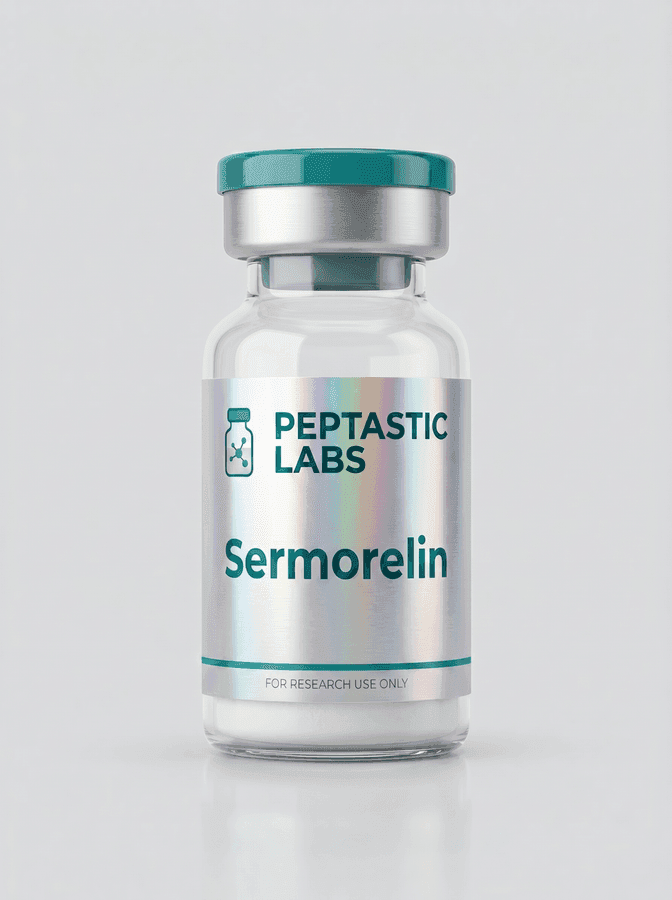
Peptastic Labs positions documented peptide materials for research use only, with a focus on lot matching, verified purity and accessible quality-control records. For technically informed purchasers, that documentation supports a practical goal: reducing uncertainty around the material so that experimental decisions can be based on the biology rather than avoidable sourcing variables.
Building a more informative research programme
The strongest sermorelin studies begin with a narrow question. Is the objective to quantify acute growth hormone release, map GHRH receptor signalling, compare responsiveness between models, or examine downstream endocrine feedback? Each objective calls for different sampling windows, analytical endpoints and controls.
It is equally useful to define what the study cannot show. An in vitro cAMP response cannot demonstrate systemic endocrine regulation. A short animal study cannot establish a durable tissue outcome. A rise in IGF-1 cannot, by itself, explain the upstream secretory pattern that produced it. Stating these boundaries improves interpretation and makes follow-up experiments easier to design.
A well-documented peptide, a timing-aware sampling plan and disciplined endpoint selection can turn a simple hormone measurement into credible growth hormone axis research. That is where sermorelin is most useful: not as a shortcut to a conclusion, but as a precise research tool for asking better questions about endocrine signalling.
For research use only. Not for human or veterinary use. Not for consumption. Nothing in this article is medical advice or a recommendation for use in humans or animals.