HPLC Testing for Peptides and What COAs Prove
· Peptastic Labs
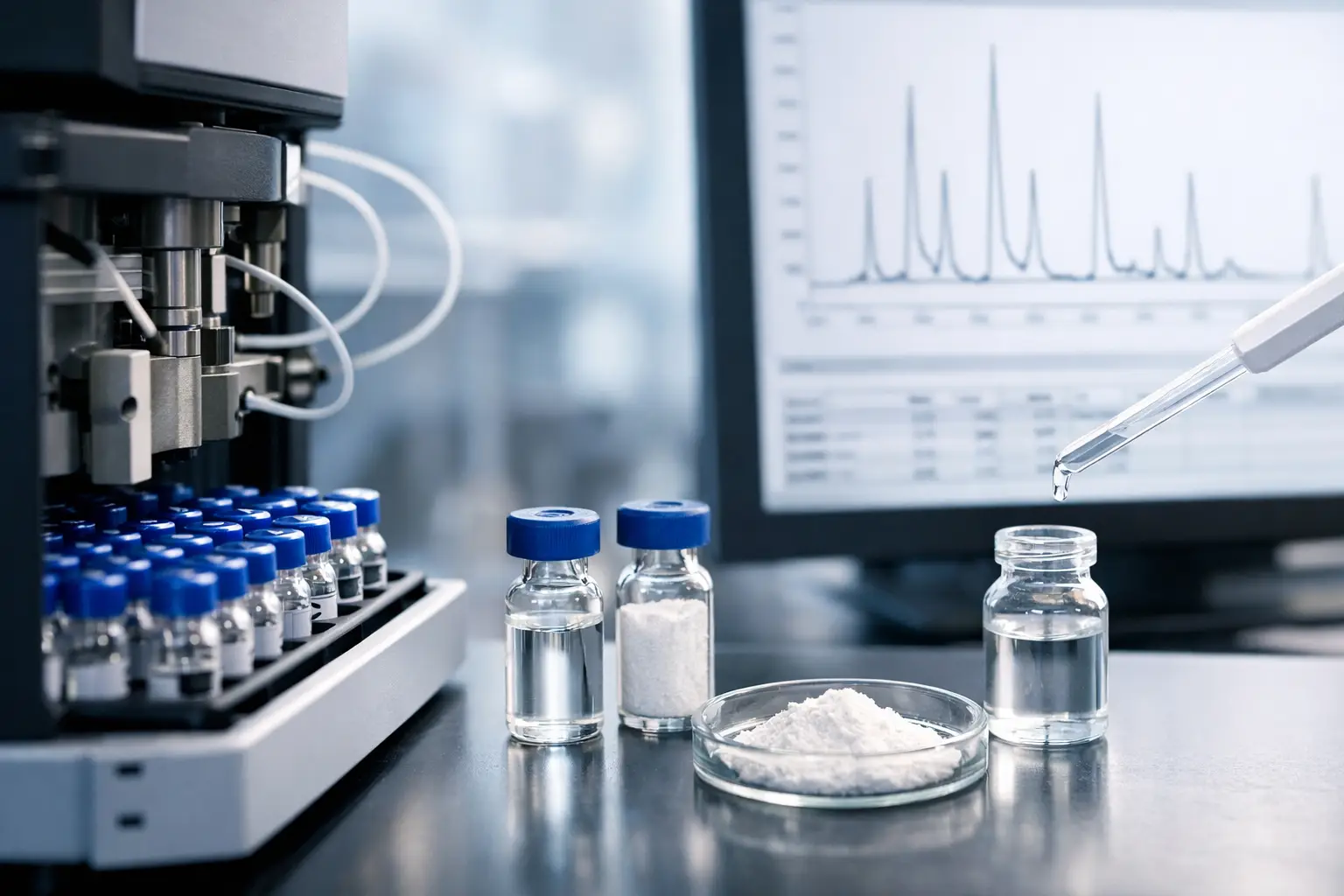
A peptide vial can be labelled with a familiar sequence and still leave critical questions unanswered. Is the material predominantly the intended peptide? Are related impurities present? Does the documentation belong to the exact lot being evaluated? HPLC testing for peptides is one of the most useful ways to address those questions, provided the chromatogram and Certificate of Analysis (COA) are read for what they actually demonstrate.
For research buyers, HPLC is not merely a percentage printed beside a product name. It is a batch-level quality-control tool that can support purchasing decisions, method development and reproducible experimental planning. It also has defined limits. A high HPLC purity result is valuable evidence, but it does not independently establish every aspect of a peptide’s identity, concentration or suitability for a particular research workflow.
What HPLC testing for peptides measures
High-performance liquid chromatography separates components in a sample as they move through a column under controlled solvent conditions. In peptide analysis, reversed-phase HPLC is commonly used. The peptide mixture travels through a stationary phase while a changing mobile-phase composition, often involving water and an organic solvent, elutes compounds at different retention times.
A detector records the material as it exits the column, producing a chromatogram. Each visible peak represents a component or group of closely related components detected under that method. The main peak is generally assigned to the intended peptide, while smaller peaks may indicate synthesis by-products, deletion sequences, oxidation products, aggregation-related species or other impurities.
Purity is often reported as the main peak area divided by the total detected peak area, expressed as a percentage. If the principal peak represents 99% of the integrated area, the result may be reported as 99% HPLC purity. That figure is useful, but it is method-dependent. Detector wavelength, column chemistry, gradient design, integration settings and sample preparation can all affect the chromatogram and the calculated result.
Why peptide separation is technically demanding
Peptides vary in length, charge, hydrophobicity and amino-acid composition. Minor sequence changes can create compounds with very similar chromatographic behaviour. A deletion impurity or oxidised variant may resolve cleanly from the target peptide under one method but partially overlap under another.
That is why a credible HPLC result should be considered alongside method details rather than treated as a stand-alone marketing number. A clear chromatogram, a stated analytical method and lot-specific documentation provide far more context than a generic purity claim.
Reading a peptide chromatogram with the right questions
The main peak should be prominent, appropriately integrated and consistent with the reported retention time. Smaller peaks deserve attention as well. Their number, size and separation from the principal peak can indicate whether the sample contains readily detectable related material.
A clean-looking chromatogram is encouraging, though visual interpretation has limits. A single symmetrical peak does not automatically prove that only one chemical entity is present. Co-eluting impurities can travel together and appear as one peak. Conversely, a small shoulder beside a main peak might represent a genuine impurity, incomplete separation or a sample-handling artefact.
When reviewing a chromatogram, ask whether the document identifies the lot number, test date, detector wavelength, column or method conditions, and reported purity calculation. The appropriate level of detail depends on the research setting, but traceability is non-negotiable. The analytical record should match the material in hand, not a previous production run or a representative batch.
What a Certificate of Analysis should establish
A COA converts an analytical result into a usable quality record. For peptide procurement, the most practical documents tie the product name, batch or lot number, test method and result together. A QR code or lot-matched record can make verification faster, but the underlying information is what matters.
A well-prepared peptide COA commonly records the reported HPLC purity, a chromatogram or reference to the analytical output, and identity data such as mass spectrometry results. It may also include the date of manufacture or testing, storage guidance, appearance, peptide content or net weight, depending on the supplier’s quality system.
Identity testing and purity testing answer different questions. HPLC supports separation and relative purity assessment. Mass spectrometry supports confirmation that the observed molecular mass aligns with the expected peptide mass. Used together, they provide stronger evidence than either test alone. For sequence-critical work, researchers may require additional characterisation beyond these routine release tests.
Third-party testing can add an independent layer of confidence, particularly where the laboratory, method and lot connection are transparent. It should not be confused with a blanket guarantee that every possible contaminant has been excluded. The scope of the test determines the scope of the claim.
What HPLC purity does not tell you
The most common mistake is treating an HPLC percentage as a complete quality profile. It is not. HPLC area purity does not necessarily establish absolute peptide content, because response factors and non-peptide components may not be represented in the same way by the detector. A sample can show a high main-peak area while its actual peptide quantity requires separate evaluation.
Nor does a routine HPLC chromatogram inherently confirm sterility, endotoxin level, bioburden, residual solvent content, elemental impurities, counterion composition or moisture content. Those characteristics require specific methods and should only be assumed when they are explicitly tested and documented.
This distinction matters when designing research protocols. A cell-based assay may be particularly sensitive to endotoxin. A quantitative receptor study may require a carefully characterised concentration. Stability work may need information about oxidation, deamidation, freeze-thaw exposure and storage duration. The correct testing package depends on the experimental question.
HPLC also cannot change the intended status of a material. Research-grade peptides are supplied for research use only and are not approved for human use, therapeutic administration or consumer wellness applications. Analytical documentation supports responsible laboratory sourcing and handling; it does not convert a research material into a medicine.
Storage and handling can alter the tested material
A COA describes the lot at the time of testing. It does not guarantee that every aliquot will remain unchanged after transport, repeated opening or unsuitable storage. Peptides can be affected by moisture, heat, light, oxidation and repeated freeze-thaw cycles. Hygroscopic material may also gain water during handling, complicating accurate weighing and solution preparation.
Researchers should retain lot records, follow the supplier’s stated storage conditions and document reconstitution solvents, concentrations and dates. Where repeatability is central to the project, preparing controlled aliquots can reduce unnecessary handling of the parent vial. If an unexpected result appears later, those records help distinguish a biological observation from a possible material or handling variable.
A practical standard for sourcing documented peptides
For routine research procurement, start with the evidence that is directly relevant to your work: lot-matched HPLC data, reported purity, identity confirmation, storage information and a clearly stated research-use-only status. Then assess whether the supplier makes the documentation accessible before purchase and whether the batch identifiers on the label and COA agree.
Peptastic Labs approaches research-grade supply with this documentation-first standard, making batch-specific COAs and verified purity information part of the purchasing record rather than an afterthought. For investigators comparing materials across suppliers or across repeat orders, that traceability can save time when results need to be reviewed months later.
The best purchasing decision is rarely based on the highest percentage alone. It is based on whether the analytical evidence is matched to the lot, adequate for the intended experiment and interpreted without overstating what the method can prove. Treat the chromatogram as a piece of research data, not just a badge on a product page, and it becomes far more useful.
For research use only. Not for human or veterinary use. Not for consumption. Nothing in this article is medical advice or a recommendation for use in humans or animals.