How to Reconstitute Lyophilised Peptides
· Peptastic Labs
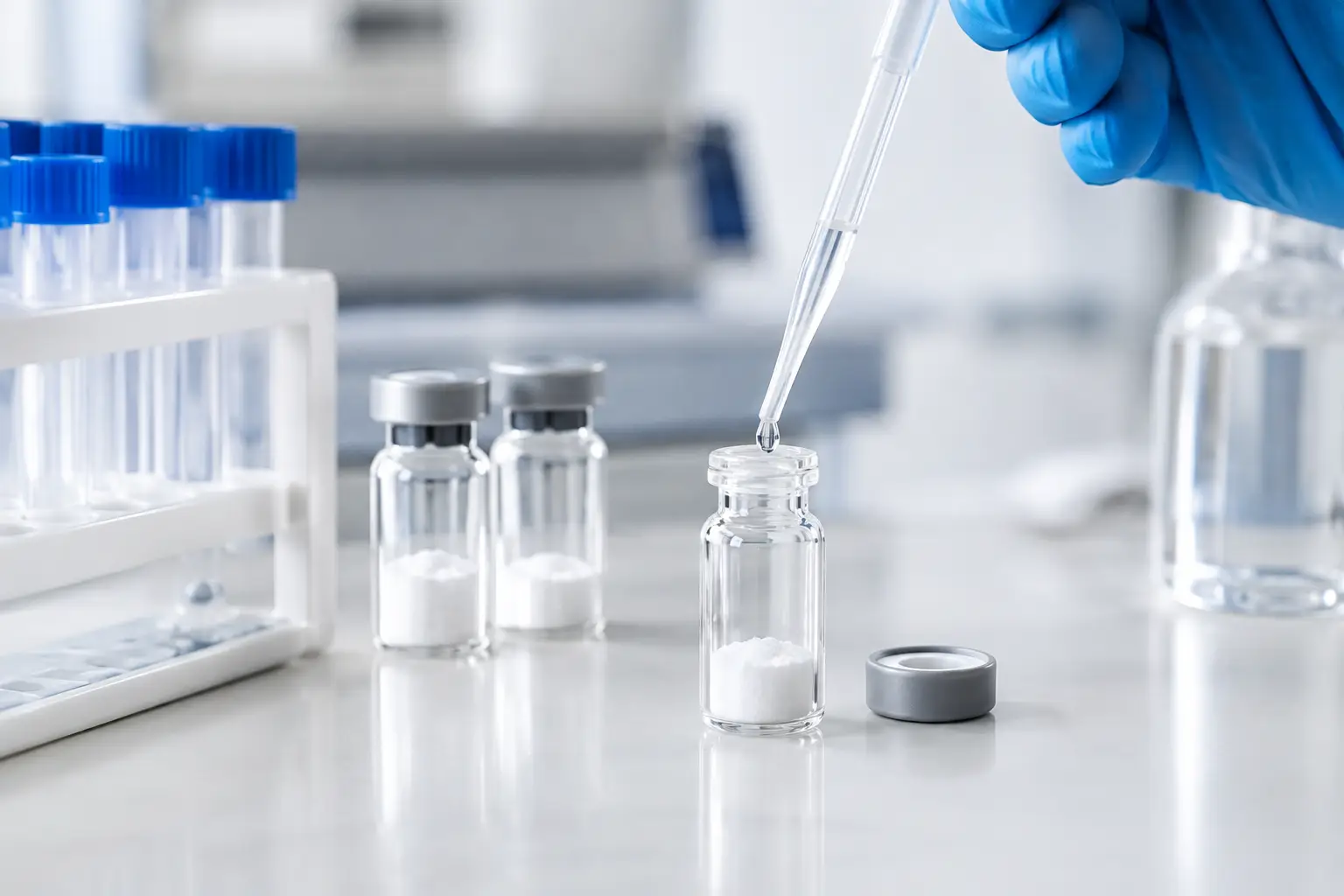
A lyophilised peptide may arrive as a clean white cake, a thin film, or a loose powder, but the appearance alone does not tell you how it should be handled. Knowing how to reconstitute lyophilised peptides begins with the material’s identity, expected solubility, intended assay conditions, and lot-specific documentation. For research use only, reconstitution is a controlled laboratory preparation step - not a one-size-fits-all instruction and not a protocol for human administration.
The objective is straightforward: return the peptide to solution at a known concentration while minimising contamination, degradation, adsorption and calculation errors. The practical details matter because a poorly chosen solvent or an undocumented dilution can compromise an otherwise well-designed experiment.
How to Reconstitute Lyophilised Peptides for Research
Before opening the vial, review the product label, lot number, Certificate of Analysis and any supplied handling guidance. Confirm the peptide name, molecular weight, net peptide content where reported, purity result, storage condition and analytical method used for identity or purity verification. A COA supports traceability and quality assessment, but it does not automatically establish the best working solvent for every assay.
Allow a cold vial to equilibrate to room temperature while still sealed. This reduces the chance of condensation forming inside the vial after opening. Moisture is the enemy of many lyophilised materials, particularly hygroscopic peptides and compounds with known hydrolytic sensitivity.
Work in an appropriate clean environment using suitable personal protective equipment and laboratory aseptic technique. Use sterile, low-retention pipette tips and properly labelled tubes or vials. If the work requires sterility, use an established sterile workflow rather than assuming that a research material, even one supplied with high reported purity, is sterile by default.
Start with the research question, not a default solvent
Water is often a reasonable starting point, but it is not universally suitable. Peptide sequence, length, charge, hydrophobicity, disulphide content and assay matrix all influence solubility and stability. A highly basic peptide may behave differently from an acidic or hydrophobic sequence, even when both arrive in similar-looking lyophilised form.
The right diluent depends on the validated method or the requirements of the experiment. Common research diluents include purified water, buffered aqueous systems, saline-based media and, where scientifically justified, a compatible organic co-solvent used to create a concentrated stock before further dilution. Buffer pH, ionic strength and the final solvent percentage can affect aggregation, receptor assays, cell viability and analytical results.
Do not select a solvent purely because it is convenient or commonly discussed online. Instead, consult the peptide’s technical information, relevant published methods, internal method development records and the needs of the experimental system. If no validated guidance exists, perform a small-scale solubility and stability assessment before committing limited material to a larger study.
Calculate the Concentration Before Adding Diluent
Reconstitution errors often begin with a simple mismatch between mass, volume and intended concentration. Write down the target stock concentration before pipetting. The basic relationship is:
Concentration = amount of peptide / final volume
For example, if a vial contains 1 mg of peptide and the experimental plan requires a 1 mg/mL stock, the final volume is 1 mL. If the same vial is needed as a 0.5 mg/mL stock, the final volume is 2 mL. Where molar concentration is required, use the peptide’s molecular weight from the lot documentation or product specification to convert mass into moles.
The stated vial quantity may not always equal the exact amount available for a specific analytical purpose. Some materials are supplied as a nominal mass, while others may be formulated or packaged with handling considerations in mind. Use the supplier’s stated content and documentation, then record the calculation and assumptions in the experiment file.
For low-concentration assays, prepare a concentrated, well-characterised stock where compatible with the method, then make serial dilutions using an appropriate assay diluent. This can improve pipetting accuracy and reduce repeated freeze-thaw exposure of the primary stock. It also makes errors easier to identify because every dilution step is documented.
Add diluent gently and allow the peptide to hydrate
After selecting the diluent and confirming the volume, direct the liquid slowly down the inside wall of the vial where practical. Avoid forcefully jetting the solvent onto the lyophilised cake. Cap the vial and allow it to stand briefly so the material can hydrate.
Mix by gentle swirling or slow inversion where the container permits. Aggressive shaking can introduce foam, air-liquid interface stress and, for some peptides, aggregation. If the material does not dissolve promptly, do not assume it has failed. Solubility can depend on time, temperature, concentration and pH.
A brief low-intensity vortex may be acceptable for certain materials and validated workflows, but it should not be the automatic first step. Likewise, sonication, heating or pH adjustment may help in specialised method development, yet each can create new stability concerns. Use those approaches only when supported by compound-specific evidence and the experimental design.
Inspect the resulting solution under suitable lighting. Note whether it is clear, opalescent, coloured or visibly particulate. A clear solution does not prove identity or stability, but unexpected cloudiness or persistent particles should prompt investigation before the material enters an assay. The cause may be incomplete dissolution, precipitation after pH change, incompatibility with the diluent or contamination.
Protect Stability After Reconstitution
Lyophilisation generally improves storage stability, but reconstitution changes the risk profile. In solution, peptides can be affected by hydrolysis, oxidation, deamidation, adsorption to surfaces, aggregation and microbial contamination. The degree of risk varies substantially by sequence and solution conditions.
Aliquoting is often useful when repeated sampling would otherwise expose one stock vial to multiple freeze-thaw cycles. Prepare aliquots in appropriately sized, clearly labelled low-bind tubes where adsorption is a concern. Each label should include the peptide identity, lot number, concentration, diluent, preparation date, preparer and any storage condition relevant to the study.
Store the reconstituted material according to compound-specific guidance or the established method. Refrigerated storage may be appropriate for short-term use, while frozen aliquots may be preferred for longer retention, but no generic temperature rule fits every peptide. Light-sensitive materials should be protected from light, and solutions containing oxidation-prone residues may require additional method-specific controls.
Avoid treating a published stability window as universal. Stability can change with concentration, vial material, oxygen exposure, buffer composition and freeze-thaw history. For critical work, confirm stability under the actual conditions used in the study through an appropriate analytical or functional check.
Documentation Is Part of the Preparation
A reproducible reconstitution record should capture more than the final concentration. Record the original lot number, COA reference, vial mass or stated content, chosen diluent, added volume, calculation, date, storage location and observed appearance. If the sample is transferred to a new tube, preserve the chain of identity between the working tube and the original lot.
This level of documentation is especially valuable when assay results need to be compared across batches, operators or time points. It also helps distinguish a biological finding from a preparation variable. If an experiment produces an unexpected result, the reconstitution log is often one of the first places to look.
For documented research materials, lot matching matters. A Certificate of Analysis, third-party purity data and traceable product records provide a starting point for quality review, while the laboratory’s own preparation records complete the chain. Peptastic Labs treats both sides of that process as relevant: verified material documentation before purchase, followed by disciplined handling after the vial arrives.
Common Reconstitution Problems and What They May Mean
Persistent insolubility does not always mean the peptide is unsuitable. The concentration may be too high, the pH may be unfavourable, the ionic strength may be driving aggregation, or the selected solvent may simply be incompatible with the sequence. Return to the method rationale rather than repeatedly mixing harder.
Precipitation after dilution can indicate that a concentrated stock was soluble in its initial solvent but not in the final assay medium. In that situation, check the final co-solvent percentage, order of addition and target concentration. A different stock concentration or a revised dilution scheme may be needed.
If replicate results drift over time, consider solution age, storage history and repeated vial access alongside biological explanations. A peptide stock can look normal while still undergoing chemical change that affects assay performance. Where the data carry significant weight, analytical confirmation may be warranted.
The best reconstitution approach is the one that is chemically defensible, compatible with the assay and fully traceable. Treat the vial, solvent choice and calculations as parts of the experimental method, not as a preliminary chore. That discipline gives the resulting data a far better foundation.
For research use only. Not for human or veterinary use. Not for consumption. Nothing in this article is medical advice or a recommendation for use in humans or animals.